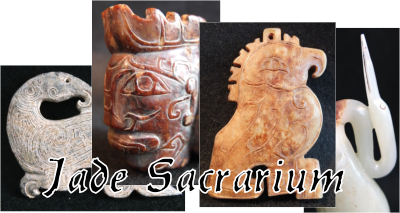
Dragon disk with flange Mottled green opaque jade with cracks and erosion; calcification and reddish and yellow suffusion also present. The disk part of the dragon's body has three wide, deep circular grooves and 6 or 7 narrow ones. The mouth and tail are formed by a toothed hole and an inverted comma shaped hole. No indication of the animal's eye - an unusual omission; none of the similar jades that have been published have one either - cf. Shang and Western Zhou Jades, Throckmorton Fine Art, 2010, pp. 104-109 The Throckmorton jade is listed as 'Shang/Western Zhou' period. Most of the circular grooves are very uniform, that is, as if they were incised while the jade was turning in a lathe. 17.6 x .48 cm ( flange 1.69 thick, 7.73 dia).
When I first handled this jade (and Flanged Dragon 2) it was very 'gritty' on the surface - as if an abrasive were imbeded in it.
This led me to speculate that it had been used originally as an abrasive tool.
Several other observations came into play: These flanged animals are not that rare - there are fish and birds, as well as dragons fashioned in this manner. The flange is often broken in part , or even missing on these 'circular, flat animals'. It would represent an enormous expenditure of jade to create these flanged items (a lot of jade has to be removed) - why is the decoration so sparse? Why are there grooves and ribs which have little counterpart in the Shang decorative vocabulary? The uniform notches on the rim might be left over from the original use.
If these flanged disks were originally made for some other purpose, then their reuse as animals would make sense. It would be an economical way of salvaging the jade material when the tool was no longer serviceable.
My SWAG analysis is, these flanged disks were originally used to carve or cut jade or hard stone. The central flange allowed them to be mounted on an axle and turned while the material to be cut was brought
to bear with abrasive and pressure. |